Showing posts with label project management. Show all posts

Wednesday, July 30, 2014

Project Management: Enterprise Surveys


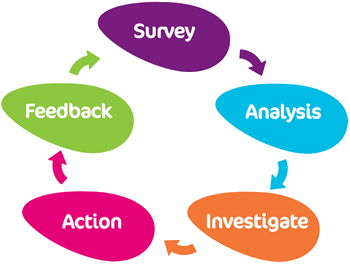
Here is a broad outline of the various decisions/considerations in the survey cycle:
  • Survey Format/Web/Paper - Does your target audience have web/email access and/or can you provide computer kiosks? Paper should be avoided due to high cost and strict logistics.
  • Languages/Translations - How many languages, who will coordinate translations, and how much time will be needed for the entire process, including quality control checks?
  • Timeframe/Length of Data Collection - When do you want the survey to launch: Annually? Bi-Annually? Quarterly? How long will each data collection window be: 2 weeks? 3 weeks?
  • Survey Content/Paths/Design - What are your current business successes/challenges and how will survey content align with feedback/data collection results you hope to gain? Will survey content be universal, or will you tailor content for different levels/departments?
  • Confidentiality/Ethics/Access - Will the survey be anonymous or individually authenticated? What level of confidentiality is required by all parties, and how will confidentiality affect end-user response rates? What is the minimum number of participants required to share results?
  • Branding/Logo/Communications - Will you use existing templates, or require custom branding and design? How will you communicate to your audience before, during, and after the survey?
  • Participant Files/Hierarchies - Will any participant information (Name, Email, Level, Department, etc.) be provided in advance, or will it be collected during the survey? Will you need to produce participant hierarchies for response rate or reporting purposes?
  • Qualitative/Quantitative Data Collection - Will survey data be collected in quantitative scales (i.e. rating of 1-10 or Likert scale), or will survey data include qualitative open ended comment responses that need to be analyzed for word groupings and themes?
  • Data Analysis/Cuts/Graphic Views - What statistical data analyses will be performed, and how will the results be presented: bar charts, line graphs, heat maps, conditionally formatted tables, infographics, word clouds, etc.? 
  • Online/Offline Reporting/Delivery Method - Who will receive data analysis reports and how will access be monitored? How will data analysis reports be delivered: via internal or external shared website, mobile device, email/paper?
  • Training/Help Desk Support/Action Planning - Will the end-user need to be trained to access the survey or read reports, will a dedicated help desk be required at any stage in the process, and what will be required of users receiving reports post-survey to address the findings and outcomes?

Tuesday, March 20, 2012

Learning Management: Project Planning


This post explores the elements of the initiation and planning stages of project management. As outlined below, the following information should be included in a project proposal and project plan.

Project Proposal
Purpose - Organizational goal
Scope - Breadth and depth of project
Resources - Content and/or personnel assistance needed
Anticipated Outcomes - Deliverables and benefits provided to organization
Constraints - Internal and External
Personal Commitment - Confidentiality and personal standards of conduct

Project Plan
Overview - Describe project concept and history
Phases - Data collection, data analysis, needs assessment, interim reporting
Action Steps - Decisions, meetings, deliverables, review points
Tasks - Chronological sequence of events to complete action steps
Instruments - Schedules, software, surveys, handouts
Cost Estimates - Estimation of resources necessary to complete project

Project reporting will be outlined in a future post.

Image Credit: http://www.mpmm.com/project-management-methodology.php

Tuesday, December 27, 2011

Learning Management: eLearning Landmines

Defusing Landmines in eLearning Projects
Notes from #CETS11 - Chicago eLearning and Technology Showcase

There are many ways eLearning designers and developers can prevent potential project "landmines". In her keynote speech, Jennifer DeVries outlined several "landmines," as well as tasks and tips to prevent them toward helping keep your eLearning project a success. Some of these tips are as follows:

** Test authoring tool and delivery platform (LMS) early in the process, preferrably on target audience computer.
** Schedule SME meetings, and set time expectations early and often.
** Compare scope to status regularly (i.e. course length, content, media).
** Build several revision cycles into your eLearning plan; base the number of revisions on the number of reviewers.
** Use a project tracker to gauge deliverable stages, and budget vs. actual hours.

The document accompanying the presentation, eLearning Scoping Questions, can be found here on the CETS11 Slideshare page. This document outlines 5 questions to ask your client in order to set the project scope and expectations prior to all your hard work.

These 5 areas are:
1) Stakeholders/ Owners and Results Needed
2) Previous eLearning Projects and Expectations
3) Target Audience and Course Delivery
4) Existing Content
5) Course Development/ Production

Reference:
DeVries, J. (2011) Defusing Landmines in eLearning Projects. Keynote Address - http://chicagoelearningshowcase.com/