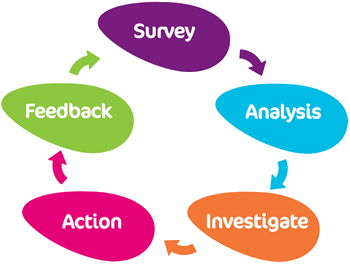
Here is a broad outline of the various decisions/considerations in the survey cycle:
- Survey Format/Web/Paper - Does your target audience have web/email access and/or can you provide computer kiosks? Paper should be avoided due to high cost and strict logistics.
- Languages/Translations - How many languages, who will coordinate translations, and how much time will be needed for the entire process, including quality control checks?
- Timeframe/Length of Data Collection - When do you want the survey to launch: Annually? Bi-Annually? Quarterly? How long will each data collection window be: 2 weeks? 3 weeks?
- Survey Content/Paths/Design - What are your current business successes/challenges and how will survey content align with feedback/data collection results you hope to gain? Will survey content be universal, or will you tailor content for different levels/departments?
- Confidentiality/Ethics/Access - Will the survey be anonymous or individually authenticated? What level of confidentiality is required by all parties, and how will confidentiality affect end-user response rates? What is the minimum number of participants required to share results?
- Branding/Logo/Communications - Will you use existing templates, or require custom branding and design? How will you communicate to your audience before, during, and after the survey?
- Participant Files/Hierarchies - Will any participant information (Name, Email, Level, Department, etc.) be provided in advance, or will it be collected during the survey? Will you need to produce participant hierarchies for response rate or reporting purposes?
- Qualitative/Quantitative Data Collection - Will survey data be collected in quantitative scales (i.e. rating of 1-10 or Likert scale), or will survey data include qualitative open ended comment responses that need to be analyzed for word groupings and themes?
- Data Analysis/Cuts/Graphic Views - What statistical data analyses will be performed, and how will the results be presented: bar charts, line graphs, heat maps, conditionally formatted tables, infographics, word clouds, etc.?
- Online/Offline Reporting/Delivery Method - Who will receive data analysis reports and how will access be monitored? How will data analysis reports be delivered: via internal or external shared website, mobile device, email/paper?
- Training/Help Desk Support/Action Planning - Will the end-user need to be trained to access the survey or read reports, will a dedicated help desk be required at any stage in the process, and what will be required of users receiving reports post-survey to address the findings and outcomes?

